Slowing down activity of fresh produce using packaging
Vegetables, fruit and flowers are still active after harvest. By consequence, they breath! They take up oxygen (O2) and release heat and carbon dioxide (CO2). Packaging can be used to slow down respiration activity and maintain quality longer. Be aware! There are also risks if not applied well.
Bringing a product to sleep with Modified Atmosphere Packaging (MAP)
An MA (Modified Atmosphere) packaging means that the air composition (O2 and CO2) in the bag or container differs from the atmospheric gas conditions. By using Modified Atmosphere Packaging (MAP), the oxygen content (O2) is reduced and the CO2 content in the packaging is increased. This leads to a strong reduction in fruit and vegetable activity. It is also said: “the product is put to sleep”. The respiration of the fresh product is drastically reduced under these conditions to save energy in the product. This results in a slower loss of quality and therefore a longer shelf life.
MA packaging is suitable for products with a limited shelf life. The storage temperature must be kept as stable as possible throughout the chain and as cold as possible (2-4°C). But beware of products that are sensitive to cold damage, they must be stored at a high temperature (> 10°C).
Basic principle of MAP
The basic principle of MA packaging consists of matching the respiration of the product to the degree of gas exchange through the packaging material.
Each packaging material has different properties in terms of gas exchange between the air inside and outside the packaging. This means that, depending on the type of plastic and the thickness of the film, oxygen molecules and carbon dioxide particles can be exchanged to a greater or lesser extent with the air outside the packaging. We are talking about the permeability or permeability of the packaging.
At the same time, the fresh product continues to consume oxygen and produce carbon dioxide, even in sleep mode. By selecting that packaging with gas permeability properties according to the product activity, an optimal air composition is created in the packaging. The headspace in the package can be gas purged to apply the desired initial gas mixture. The respiration of the fresh product ensures that the optimum gas conditions are reached in the packaging.
An important point of attention is that both the permeability of gas and the respiration rate are strongly dependent on the storage temperature. For example, MA packaging that is optimized for a low storage or transport temperature is not necessarily suitable for chains with a higher temperature.
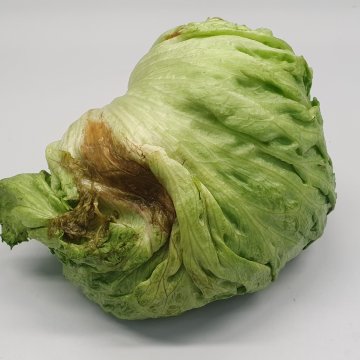
Fermentation
When the product is too active, the storage temperature is too high or the package material is too impermeable, fermentation/suffocation biological processes will appear. Due to too low oxygen inside the bag or abuse CO2 content, product is not able to survive and will decay. Off-odour, off-taste and brown discoloration are symptoms of fermentation processes.
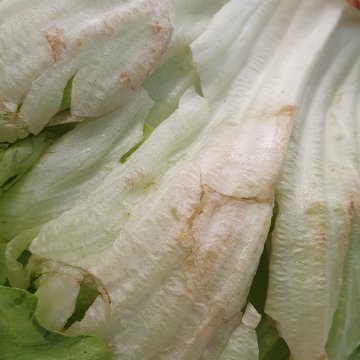
Oxidation
When the product is too little active, for instance when the storage temperature is too low or when the packaging material is too permeable to gas, oxidation processes will occur. The too high oxygen content will cause pink discoloration of lettuce for instance.
Control microbial and mould growth by MAP
Micro-organisms such as fungi and bacteria are also sensitive to the changed air composition in the packaging. The lower oxygen content and the higher CO2 content will slow down bacterial growth. Any mismatch with the desired MA conditions will in the best case lead to a loss of quality due to spoilage by bacteria and in the worst case to food poisoning due to pathogenic microorganisms. Therefore, if special deviations are detected in MA packaging, it must be discarded for food safety reasons!
How to recognize a MA-package?
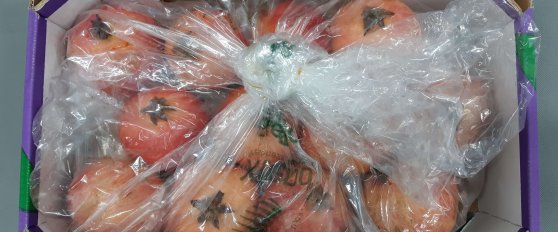
MA packaging is generally made of plastic foil
It is difficult to recognise with the naked eye MA-packaging. In general MA packaging is made of plastic foil. It is possible that this plastic foil is masked by a carboard tray for instance for marketing reason.
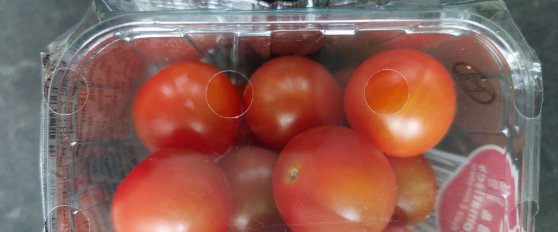
No clearly visible (macro) perforations
Furthermore a MA-package will not have visible (macro-)perforations, but there is a good chance it has small almost unvisible micro-perforations.
Check O2 and CO2 contents in the package
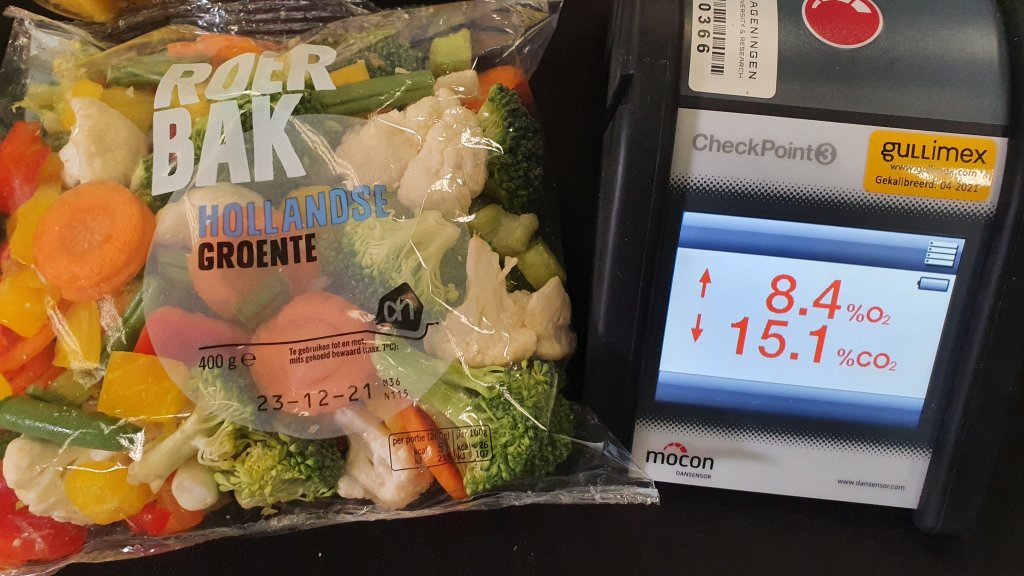
The best way to check whether you are dealing with a MA-packaging, is to measure the O2 and CO2 contents inside the package. When O2 is lower than 15-18% and CO2 higher than 2-3%, then it is a MA-packaging.

Find the microperforations
Micro-perforations can be found by applying light pressure on the bag and bring the bag in front of humidified lips and feel whether air is passing the foil. Micro-perforations are often applied over one or two lines per package and these ones are often located on the side of the package; to allow gas diffusivity when bags are stored in their secondary packaging or on the display.
Checking gas content
By measuring O2 and CO2 levels in the package, you can see if there is a leakage in a package. If the values differ from the standard, or they fluctuate between the packages, there may be a leak. It may also indicate a problem with the cold chain.
Inspecting the seals
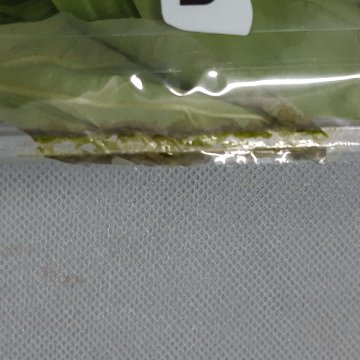
Check the seal lines for opening or folds. Also make sure that there is no product in the seal line. If you are working at the packaging line, you should sample regularly packages and control the integrity of the seal by using a seal leakage detector.
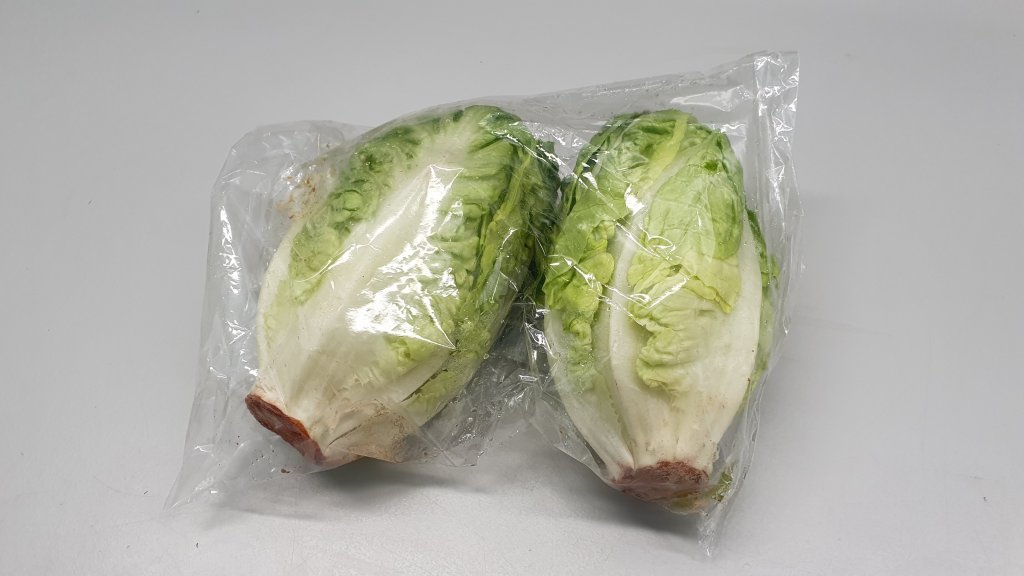
Design of MAP with microperforation
The MA-packaging needs to be optimised to the product. To realize this, food companies need to:
- Choose the packaging material (more or less gas permeable)
- Define the packaging area and the ratio product/volume
- Choose the needed amount of micro-perforations.
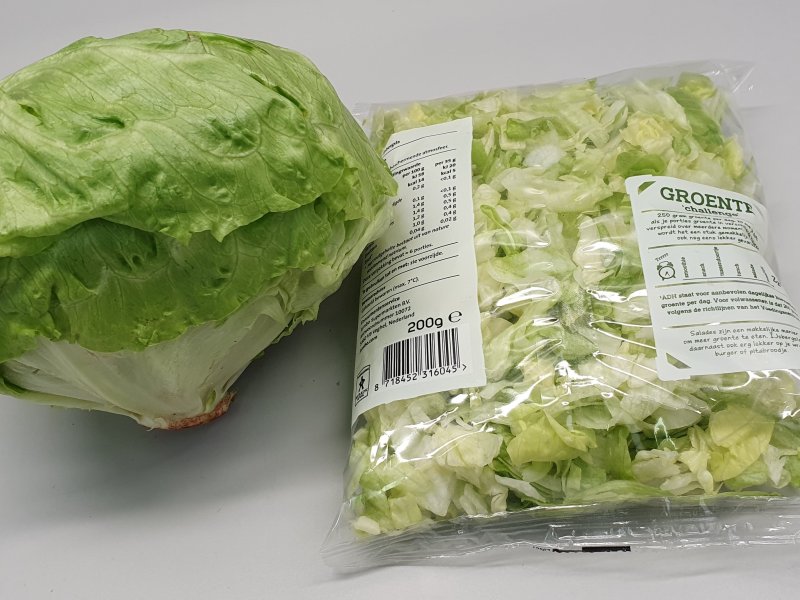
By applying micro-perforation, more O2 can enter and CO2 produced by the product, can escape the package. MAP with micro-perforations is typically used for fresh-cut mixed vegetables product.
The gas exchange through micro-perforation depends on its diameter, the thickness of the foil and the amount of micro-perforations per package.
Micro-perforations can be made in two ways, by needle or with laser. The ones added with needle are often from poor quality compared to laser micro-perforations. Laser-micro perforations have a more homogeneous form. A micro-perforation is often not visible from human eye as they have a diameter between 70 and 150µm. MAP with micro-perforations are typically used for fresh-cut mixed vegetables product.
Which packaging material is suitable for MAP?
Paper packaging without additional coating is too permeable to gas for creating the required MA gas conditions inside the package. By consequence, plastic packaging or cardboard package integrating a plastic layer is required for a MA-packaging. The three main plastic sorts: PP, LDPE and PET can be used for this purpose. Industry may use multilayer plastic materials as these ones generally have better gas barrier properties; however these plastics are not often used for fresh produce and are not sustainable because it is not possible to recycle them.
Risk of blockage of microperforations
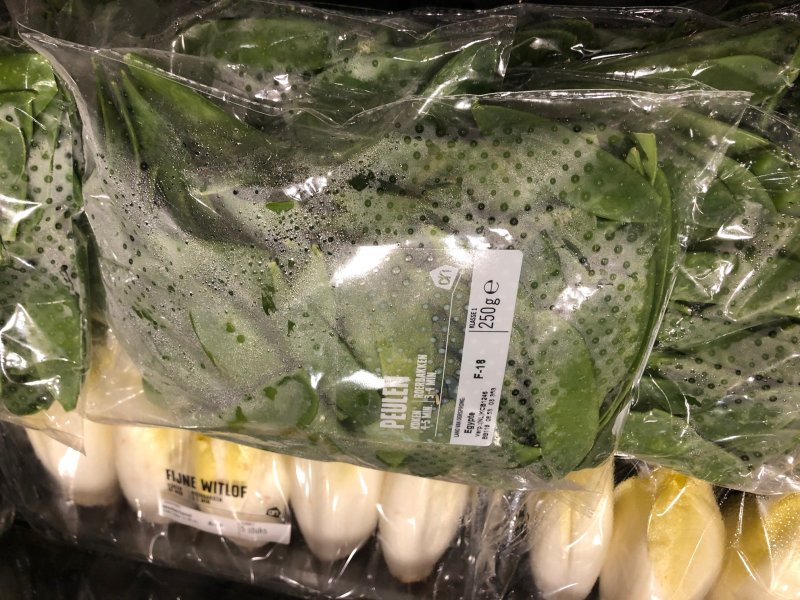
Be aware that micro-perforations are easily blocked by wrong handling of the product:
- Sticker added on top of micro-perforation line
- Too high pack density during storage
- Water condensation created by temperature fluctuation
Blockage of one or more microperforations in a package will have effect on the gas composition in the package and thus the activity of the product. This may result to discoloration of the fresh produce or production of off-smell and off-taste.
Read more about contribution of packaging to preserve quality
More information?
Wageningen Food & Biobased Research is a contract research organization that works together with companies, government authorities and other knowledge institutes. Postharvest consultancy is one of our areas of expertise.
The contents on this page was created within the project "Keurmeester van de Toekomst /Quality Inspector of the Future" with financial support from the " Knowledge and Innovation Agenda Agriculture, Water and Food in the Netherlands". Do you want to know more about packaging? Please contact our experts.