RESEARCH RESULTS
Mango: NIR measurements on the skin
In GreenCHAINge fruit & vegetables, non-destructive measurement techniques are explored and developed. The general aim is to measure quality aspects non-destructively, objectively, repeatable and reliably. Non-destructive quality measurement of mangoes is one of the aims of the project.
Objective
The objective of this research activity was to measure quality aspects of mango non-destructively, in order to use these measurements as a means to predict the quality of the mango in time.
Experiment and Results
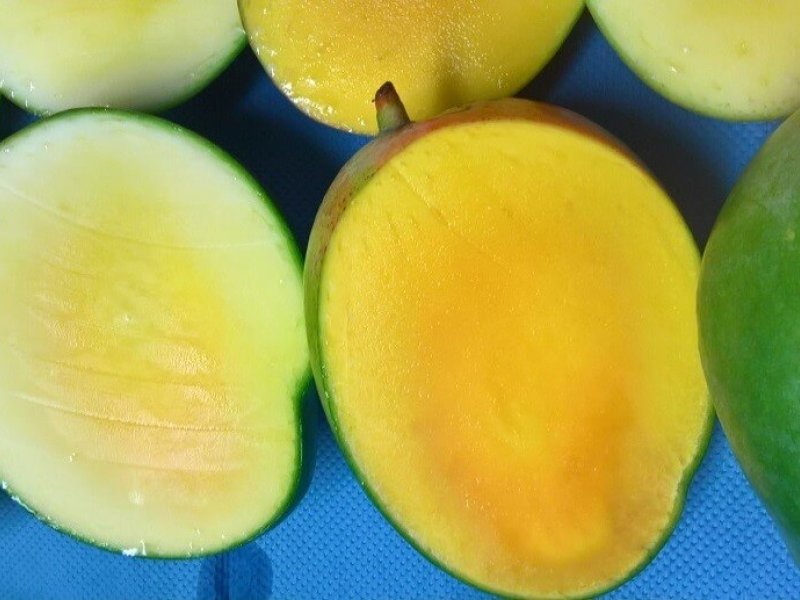
Three batches of 50 mangos were monitored for three weeks. For each mango NIR and firmness measurements were taken at three or five points in time during these three weeks totaling into 5200 measurements. For the NIR measurements a SCIO portable Near Infrared (NIR) spectrometer was used. Firmness was determined using a penetrometer.
Partial least squares regression models were employed to perform predictions. The following results were identified:
- A R2 of 0.81 was found using a single batch in dividing the data in a 60%/40% training/test split.
- A R2 of 0.76 overall was found when each batch was employed in turn as a test set. The resulting individual R2 values for batches 1, 2 and 3 were 0.74, 0.86 and 0.58 respectively.
Conclusion
NIR measurements on mango skin using the SCIO device appear promising in terms of R2 as a means of non-destructive firmness estimation. The conclusion of this experiment is that the ripening process of mangos can be monitored by using an inexpensive NIR spectrometer for measuring fruit firmness.
This allows the industry to assess individual mangos during their ripening process and make better decisions.
More information?
This project was commissioned and funded by Bakker Barendrecht, Vezet and Albert Heijn and cofunded by Top Sector for Horticulture & Starting Materials.
Questions? Please contact our experts through the contact form.