.jpg)
Loaded pallets
Pallets are useful carriers of big loads. Pallets must be strong enough to allow storage under load. There are standard sized pallets (for example 80 x 120 cm) that fit standard sized boxes. The bottom of the pallet is designed to be used by forklift and pallet jack and to allow air circulation. The packaging on the pallets must be stacked neatly and stable and stabilized by (cardboard) corners and straps. The straps should be tight but not so tight that it deforms the boxes. Instead of straps also nets are being used or film wrap. However, film wrap should not be used around boxes that need ventilation.
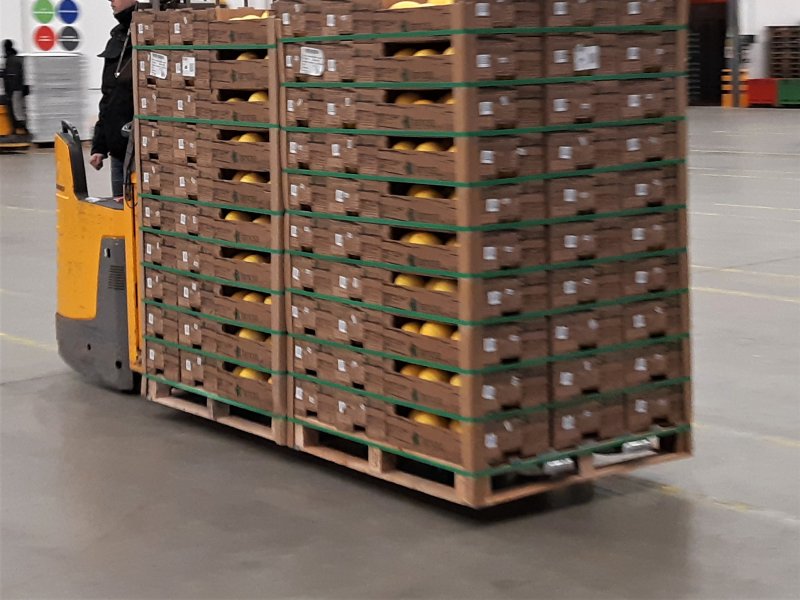
Well strapping of pallets with packaging
Pallets with packaging must be strapped well in such a way that the boxes cannot shift or fall. (Cardboard) edges are used to stabilize pallets. These corners include the pallet.
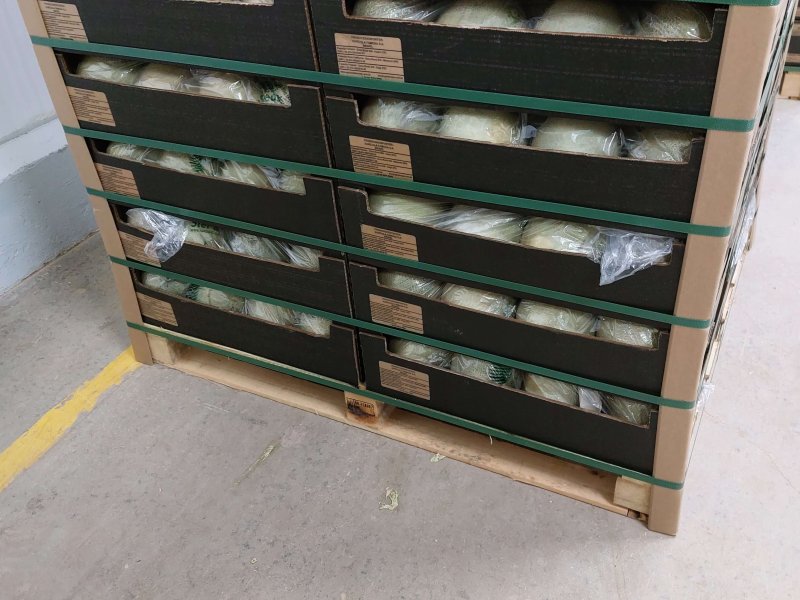
Use of corners and straps
Corners and straps are used when transporting products on pallets, to prevent pallet and boxes from collapsing. In this way, the packaging stays together well. A correct use of the binding straps (sufficiently tight and horizontal) is necessary for stability. By including corner supports, extra stability is obtained. The wrapping is done with (at least) 3 straps: on the second layer from above, in the middle of the pallet and on the first layer. Depending on the product, the packaging and the transport circumstances, more straps may be necessary.
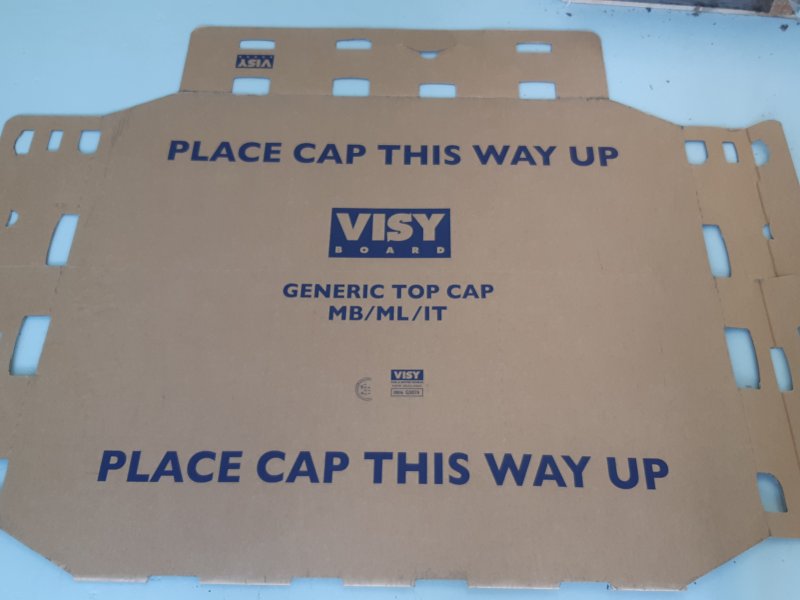
Cardboard cover for pallets
For many products, it is necessary to additionally cover the top of the pallet. This is on the one hand to prevent falling dirt in the top packaging, but sometimes also to prevent a too cold product temperature (freezing) during truck transport. Often this is a cardboard cover.
_800x600.jpg)
Neat stacking
Boxes should not overhang the edges of the pallets. This greatly reduces the strength of the boxes. As a result, the products inside can easily be damaged.
%20_800x600.jpg)
Film wrap
Film wrap should not be used on boxes that need ventilation. It can be beneficial to reduce moisture loss, but on the other hand, it reduces cold air to move through the stacks to the interior of the pallet. Product can then heat up too much. It is advisable to check the quality in the inner boxes.
%20crop_800x600.jpg)
Damage by weight
An unevenly distributed endangers the stability of the pallet. Packaging is not designed to be walked or sit on. The local heavy weight can easily damage the packaging and the products inside.
_800x600.jpg)
Damage due to poor stacking
Boxes should be properly stacked on top of each other, in a straight vertical position. Otherwise, the stacks of boxes may skew. This usually damages the boxes of the lower layers. This will damage the products in these boxes. Mark these boxes and keep them separately if necessary, as product damage may not appear until later.
%20_800x600.jpg)
Deviating pallets
The quality of the materials plays a major role in the construction of the pallet (pallet, packaging, corners, binding tape). Packaging should be stacked neatly. The full pallet must be transported carefully. When deviations are detected, extra attention should be paid to checking the product quality.
More information?
Wageningen Food & Biobased Research is a contract research organization that works together with companies, government authorities and other knowledge institutes. Postharvest consultancy is one of our areas of expertise.
Would you like to know more about packaging in practice? Please contact our experts.
The contents on this page was created within the project "Keurmeester van de Toekomst /Quality Inspector of the Future" with financial support from the " Knowledge and Innovation Agenda Agriculture, Water and Food in the Netherlands".